.png)
ARTICLE AD BOX

Eleven-year-old student Stephora died on a school trip.
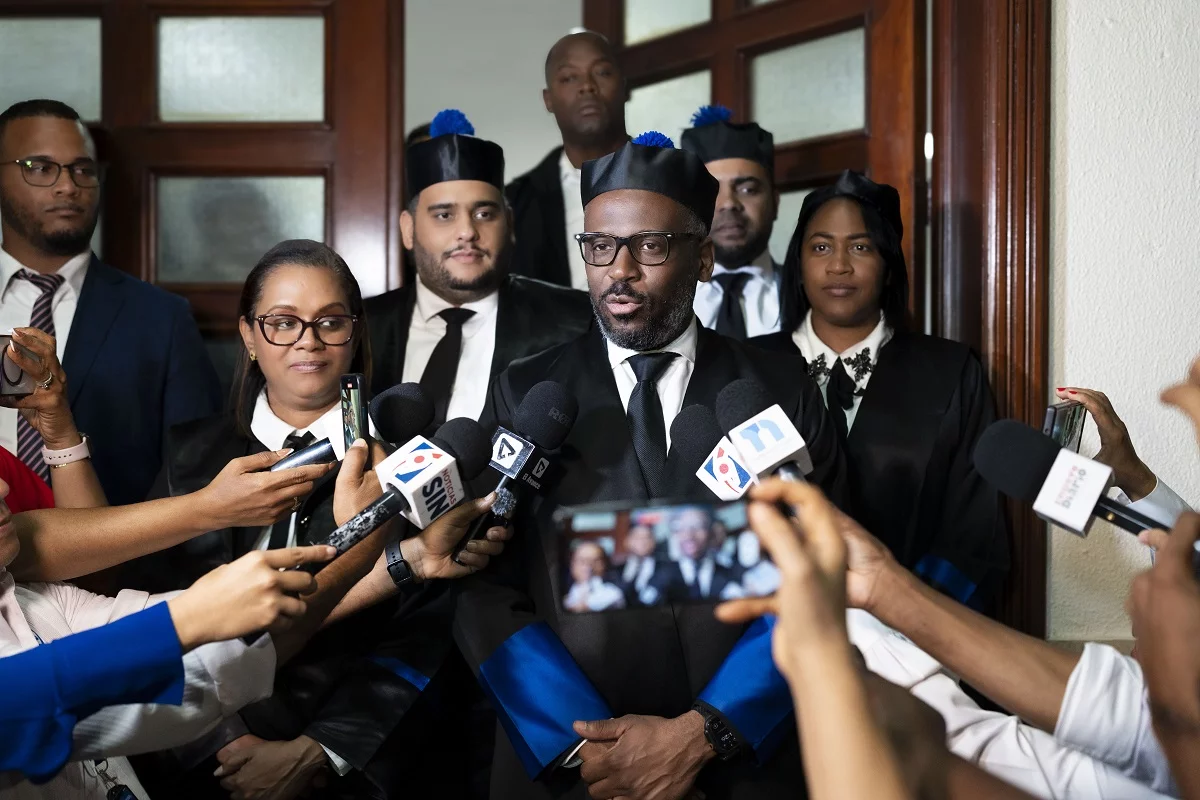
The death in the Dominican Republic of a girl of Haitian descent, who drowned in a swimming pool during a school excursion, has fueled complaints from the Haitian Government and society, which deplore “acts of violence” and “abuses” against Haitian migrants in the neighboring country. Stephora, 11 years old, drowned at a short distance from several of her classmates, who ignored her cries for help and the girl’s gestures, according to statements to the media by the lawyer of the victim’s mother, Miguel Valdemar Díaz Salazar. On that November 14, the victim was also not helped by any of the school monitors who were on the scene. Her body remained submerged at the bottom of the pool for more than thirty minutes, until it emerged to the surface full of water. “Heartbreaking stuff,” the lawyer pointed out. To date, the court in charge of the case has issued probation for three of the four employees of the school accused, while clearing the center’s general director of responsibility. For Diaz, it is anomalous that it was not until Friday, December 5, that the authorities questioned the girl’s mother. “A formal statement had not been made to the mother despite the fact that more than twenty days had passed since the death of her daughter. Normally she is the first person whose testimony is taken to find out what happened and the circumstances under which she gave up her child,” he told EFE. The lawyer considers that he can visualize “a discriminatory treatment, which has been done because of this lady and her family being Haitian.” “We have not seen such treatment in any other type of case,” he defended. The girl’s mother had also denounced to the school that her daughter was being harassed, with insults such as “damn Haitian,” she told local media. The uproar generated by this case was also echoed by Haiti’s Presidential Transitional Council (CPT), which last week urged Santo Domingo to be transparent and “apply the required measures,” and regretted the “acts of violence” and ‘abuses’ that “in recent months” have affected Haitian migrants in the neighboring country. For his part, the Haitian consul in Santiago de los Caballeros, Stephen Junior, is cautious and asked, in statements to EFE, that any allegation of harassment due to the minor’s Haitian origin “must be investigated rigorously, without hasty conclusions.” “This case must be treated with respect and without politicization. We trust in the seriousness of the Dominican judicial process and we reaffirm the importance of seeing each person as a human being with rights,” the diplomat defended. For Junior, the essential thing at this time is to know what happened “exactly” because “without that there is no justice.” “I believe that the Dominican Justice is doing a job without interference, the case is being investigated, and is on the right path to render justice,” he said. In Haiti, there was also a demonstration this week, at a point on the border with the Dominican Republic, to demand justice for Stephora’s death. Also, the organization Colectivo HaitianosRD presented a brief to the Dominican Attorney General’s Office demanding an investigation into the death of the girl and 54 other deaths documented between 2021 and 2025 in the context of massive deportations. Tension with the Haitian population has been increasing since October 2024, when Dominican President Luis Abinader ordered a policy of mass deportations of undocumented migrants. Since then, some 10,000 Haitian migrants have been deported every week despite calls from international organizations and agencies not to return them to a country where, in the first half of 2025, more than 4,000 people died as a result of armed gang violence. In this context, Amnesty International in November asked the Dominican Government to revoke the protocol linking access to health services for undocumented Haitians with deportation, as this type of action “is not justified” and “is discriminatory”. Abinader, in reference to the death of the Haitian girl, declared on Monday that in the Dominican Republic “there is no racism” and that Stephora’s death should not have happened. So far in 2025, Dominican authorities have deported more than 370,000 Haitian Dominicans, a record number in the country. It should be noted that the problem between DR and Haiti is more accurately described as cultural and political rather than racial, and that the historical fact is that Haiti once ruled the entire island: Haitians are of French culture, while the DR is Spanish. Both nations have significant African ancestries. Haitian rule over the Dominican Republic refers to the 22 years (1822-1844) during which Haiti unified the entire island of Hispaniola under its rule, following Haiti’s declaration of independence. While this unified the island and abolished slavery, it brought resentment through heavy taxes, land confiscation, suppression of the Catholic Church, and cultural clashes, fueling Dominican nationalism and leading to their War of Independence and eventual separation in 1844.Accusations of discrimination
Increase in deportations of Haitians.


 English (US) ·
  Spanish ·